
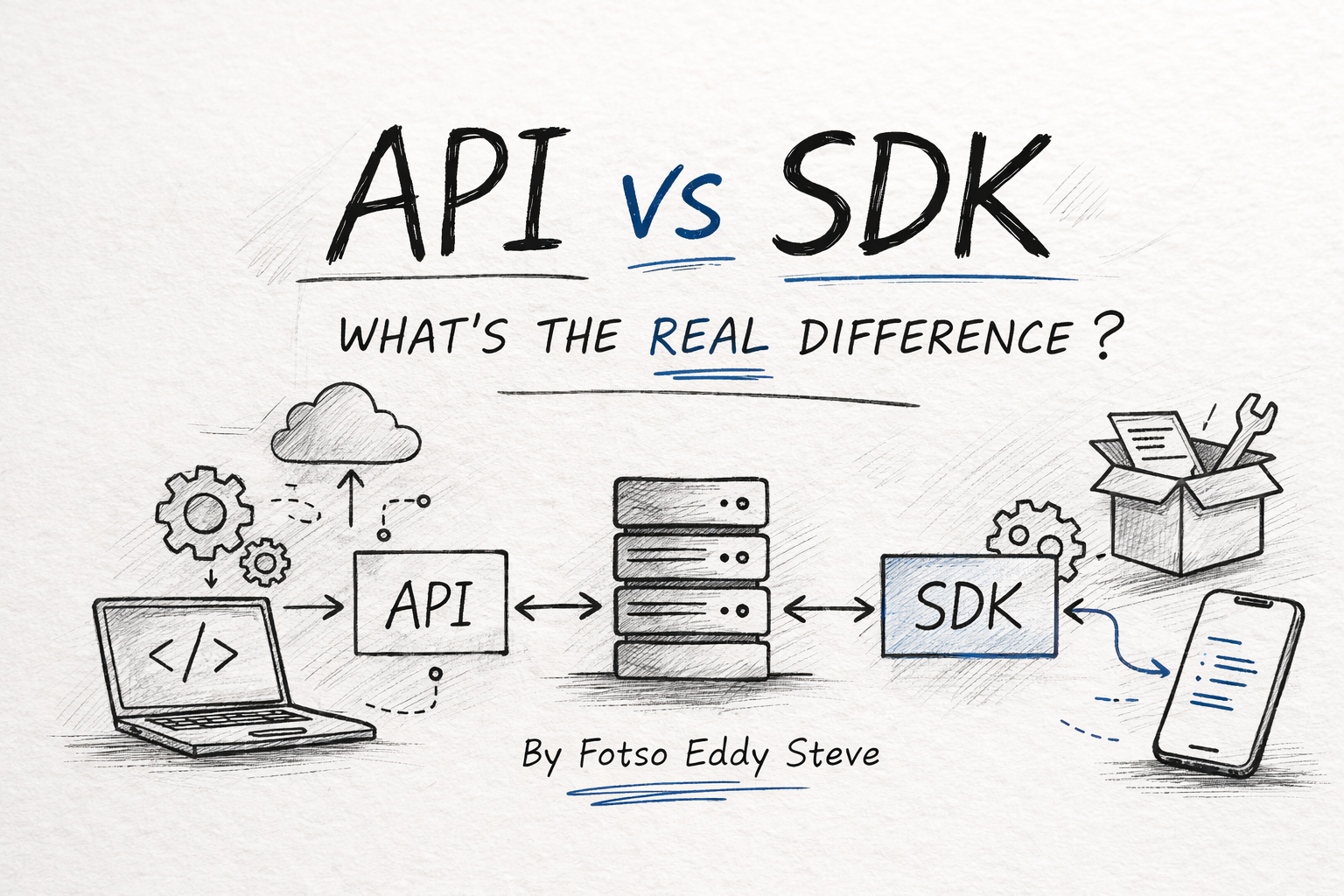
APIs and SDKs both help developers build software faster.
At first glance, they might seem similar. Both allow applications to interact with external systems. Both are commonly provided by services like Stripe, AWS, Google, or OpenAI.
But the way they work — and the reason they exist — are completely different.
An API (Application Programming Interface) defines how systems communicate.
An SDK (Software Development Kit) provides the tools that make it easier to use that communication.
Let’s explore what makes them different, why SDKs exist when APIs already do the job, and how they work together in real-world systems.
Table of Contents
- What is an API?
- What is an SDK?
- How SDKs Work
- Why Not Just Use an API?
- API vs SDK in Practice
- Key Conceptual Difference
- Control and Flexibility
- Development Speed
- Security Considerations
- Conclusion
What is an API?
An API is a set of rules that allows one software system to communicate with another.
It defines:
Available endpoints
Request formats
Response formats
Authentication methods
You can think of an API like a waiter in a restaurant.
You place your order. The waiter brings it to the kitchen. The kitchen prepares the food. The waiter returns with your meal.
You never go into the kitchen yourself — you only interact through the defined interface.
For example, if you want to get GitHub user details, you can send a request like this:
GET https://api.github.com/users/username
The server might respond with:
{

  "login": "john",

  "id": 12345,

  "followers": 120,

  "repos": 42

}
The API follows a predictable structure that both the client and server understand.
APIs are built for developers.
A developer must:
- Write the request logic
- Handle authentication
- Manage errors
- Parse responses
The API only defines the contract. The developer implements the interaction.
What is an SDK?
An SDK (Software Development Kit) is a collection of tools that helps developers build applications more easily for a specific platform or service.
An SDK typically includes:
-
Pre-built libraries
-
Helper functions
-
Documentation
-
Code samples
-
Authentication utilities
-
Error handling abstractions
If an API is the waiter, the SDK is a full kitchen toolkit with:
-
Pre-measured ingredients
-
Cooking instructions
-
Specialized utensils
It simplifies the process.
For example, instead of manually making HTTP requests to Stripe’s API, you can use their Python SDK:
import stripe

stripe.api_key = "my_stripe_key"

customer = stripe.Customer.create(
    email="fotsoeddysteve@gmail.com"
)
Behind the scenes, the SDK:
-
Formats the HTTP request
-
Adds authentication headers
-
Handles errors
-
Parses the response
But you don’t have to write that logic yourself.
How SDKs Work
Most SDKs are wrappers around APIs.
The flow typically looks like this:

The SDK translates your high-level function calls into properly structured API requests.
Instead of writing:
requests.post(
    "https://api.service.com/create",
    headers={"Authorization": "Bearer KEY"},
    json={"name": "Eddy"}
)
You simply call:
client.create_user(name="Eddy")
The SDK abstracts complexity.
Why Not Just Use an API?
You absolutely can use APIs directly.
In fact, many experienced backend engineers prefer direct API usage for:
-
Full control
-
Lightweight systems
-
Multi-language compatibility
-
Reduced dependencies
However, SDKs exist because:
-
Writing raw API calls repeatedly is time-consuming
-
Authentication and error handling become repetitive
-
Request formatting must remain consistent
-
Complex APIs can be difficult to manage manually
SDKs reduce boilerplate code and accelerate development.
They trade some control for convenience.
API vs SDK in Practice
Let’s compare a simple example: fetching weather data.
Using API Directly
import requests

response = requests.get(
    "https://api.weatherapi.com/v1/current.json",
    params={
        "key": "API_KEY",
        "q": "Delhi"
    }
)

print(response.json())
You handle:
-
Query parameters
-
API key
-
Response parsing
Using SDK
from weather_sdk import Client

client = Client(api_key="API_KEY")
weather = client.get_current("Delhi")

print(weather)
The SDK handles:
-
URL construction
-
Authentication
-
Parsing
-
Error handling
Same result. Different abstraction level.
Key Conceptual Difference
The difference between APIs and SDKs is not just technical — it’s conceptual.
API = Communication Contract
SDK = Developer Toolkit
An API exposes raw functionality.
An SDK packages that functionality in a developer-friendly form.
APIs assume:
-
You understand networking
-
You manage authentication
-
You handle edge cases
SDKs assume:
-
You want faster development
-
You prefer abstraction
-
You are working in a specific language
Control and Flexibility
API
-
Maximum control
-
Fully customizable
-
Language-agnostic
-
More verbose
SDK
-
Less boilerplate
-
Opinionated structure
-
Language-specific
-
Faster implementation
If you need fine-grained control over request behavior, APIs are often better.
If you want speed and simplicity, SDKs shine.
Development Speed
SDKs dramatically reduce development time.
They:
-
Provide pre-tested methods
-
Standardize best practices
-
Reduce repeated code
-
Improve developer experience
This is why major platforms provide official SDKs:
-
AWS SDK
-
Firebase SDK
-
Stripe SDK
-
OpenAI SDK
Because developer adoption increases when integration becomes simple.
Security Considerations
With direct APIs:
-
You manage secrets manually
-
You build authentication logic
-
You handle token refresh
-
You validate responses
With SDKs:
-
Many security best practices are built in
-
Key handling is standardized
-
Some protections are automatic
However, SDKs can also:
-
Introduce extra dependencies
-
Increase application size
-
Hide important implementation details
Security still ultimately depends on how you use them.
Final Comparison Table
| Feature | API | SDK |
|---|---|---|
| Definition | Interface for communication | Toolkit to use that interface |
| Level | Low-level | High-level abstraction |
| Language | Language-agnostic | Language-specific |
| Control | Full control | Some abstraction |
| Speed | Slower to implement | Faster development |
| Use Case | Custom integrations | Rapid application development |
Conclusion
At a glance, APIs and SDKs might seem interchangeable. But they serve different purposes.
APIs define how systems communicate.
SDKs make it easier for developers to use that communication.
An API connects software systems.
An SDK empowers developers.
They are not competitors — they complement each other.
If APIs are the foundation, SDKs are the productivity layer built on top.
Understanding this difference helps you design cleaner architectures, choose the right integration strategy, and build more maintainable systems.